
A PEG tube changes how you eat, but it does not have to change much else if the feeding routine, the tube care and the training of the people around you are handled well. This guide covers what enteral nutrition involves under the NDIS and who does what.
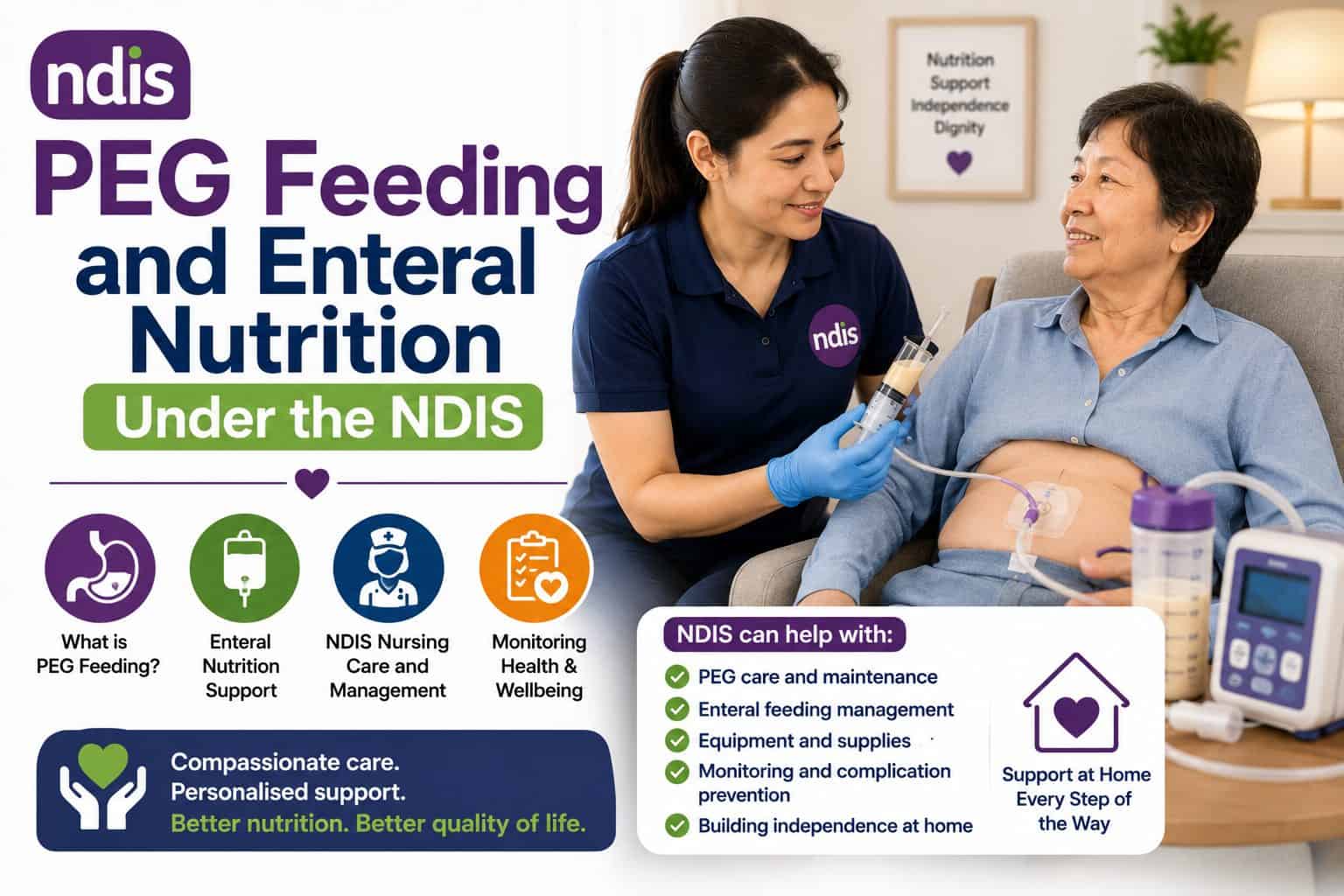
Enteral nutrition means receiving some or all of your nutrition through a tube into the stomach or small intestine. The most common route for long-term feeding is a PEG (percutaneous endoscopic gastrostomy) tube; others include a PEJ tube into the jejunum and a nasogastric tube for shorter periods. For NDIS participants the feeding itself is often straightforward. What takes organisation is the routine around it: the regime from the dietitian, the tube site care, the medications given through the tube and the training of support workers. This article sits alongside our high intensity supports service page, which describes how we deliver it.
Your dietitian prescribes the regime: which formula, how much, and whether it is given as bolus feeds several times a day, as a continuous or overnight pump feed, or a combination. Water flushes before and after each feed and each medication keep the tube clear and contribute to your hydration. Someone has to set up the feed, check the tube position and site, run the feed at the prescribed rate, flush, and record what was given.
The tube site needs daily attention: cleaning, drying, checking for redness, leakage or overgranulation, and for a PEG tube, rotating and gently moving the tube so it does not adhere to the stomach wall. The external bumper should sit comfortably, not too tight. Problems such as a blocked tube, a leaking site, vomiting or aspiration during feeds and tube displacement all have specific responses that your care plan should spell out.
Many participants with a PEG also receive their medicines through it, and this is where errors most often occur. Not every medicine can be crushed, some interact with the feed and need to be timed apart from it, and the tube has to be flushed between medicines to prevent blockage. A registered nurse works with your pharmacist to confirm which formulations are suitable, writes the administration instructions into your chart and trains the workers who give them.
Enteral feeding is listed in the NDIS High Intensity Support Skills Descriptors, which means a provider must be registered for high intensity daily personal activities and its workers must meet a defined standard before they carry it out. In our model a registered nurse assesses you, writes the care plan with the dietitian, trains each support worker on your specific tube, pump and regime, observes them, signs off their competence and reassesses on a schedule. The nurse stays responsible for the plan, reviews you regularly and is contactable during shifts. Tube changes, troubleshooting a damaged or displaced tube and any change to the regime remain with the nurse and your treating team.
The daily feeding support is funded from your Core budget at the high intensity rates, and the nursing from Core as a disability-related health support. Formula, giving sets, syringes and other consumables are also generally claimed from Core where the need relates to your disability; in some cases hospital or state schemes cover part of the supply. The NDIA expects a report from your dietitian, gastroenterologist or GP that sets out the regime, the equipment and the risks of untrained feeding.
If you are being discharged from hospital with a new PEG, the time to get this organised is before the discharge date. Our nurses train on the ward with the hospital team wherever the hospital allows, so the first feed at home is not the first feed your support worker has ever done. Our article on NDIS nursing after hospital discharge covers that transition.
Yes, after a registered nurse has trained them on your specific tube and regime, watched them do it and signed off their competence, and provided your treating team agrees. The nurse remains responsible for supervision and reassessment.
Flushing with warm water using a gentle push-pull action clears most blockages. If it does not clear, do not force it or use anything other than what your care plan specifies. Contact your nurse; a tube that cannot be cleared needs clinical attention the same day.
Usually, yes, as a consumable in your Core budget where the need for enteral nutrition relates to your disability. Some participants receive part of their supply through a hospital or state scheme. Your dietitian and plan manager can confirm the arrangement for you.
MediHealth Connect provides community nursing across South East Queensland.