
MediHealth Connect delivers positive behaviour support in Brisbane by putting your behaviour support plan into practice. Our trained support workers and nurses follow the strategies your practitioner has written, collect the data your practitioner needs and stay consistent from shift to shift.
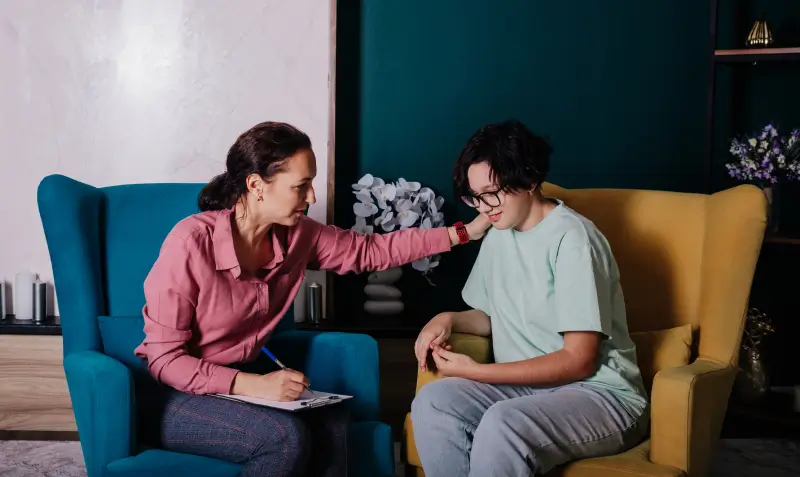
Positive behaviour support, usually shortened to PBS, is an approach that starts from a simple idea: behaviours of concern are a way of communicating something, and the best response is to understand what that something is and change the environment, the routine or the supports so the person no longer needs that behaviour. It is not about compliance or punishment. It is about quality of life.
Under the NDIS, positive behaviour support has two halves. A registered behaviour support practitioner assesses the person, works out why the behaviour happens and writes a behaviour support plan. Then the people who support that person every day, support workers, nurses, family and others, implement the plan. MediHealth Connect works in the second half. We are the team in your home and community in Brisbane making sure the plan is actually followed.
A behaviour support plan only works if every person supporting you understands it and applies it the same way. That is where most plans fail, and it is the problem our Brisbane team is set up to solve.
Before any worker supports you, they are taken through your plan: the proactive strategies, the early warning signs, the agreed responses and anything the practitioner has said must never happen. Where your practitioner offers implementation training, our staff attend it.
We keep your team small and stable. A rotating cast of unfamiliar workers is one of the most common triggers for behaviours of concern, so we build a roster around a core group who know you, your routine and your plan.
Your practitioner needs accurate information to know whether the plan is working. Our workers record what happened, what came before it, how they responded and what followed, in the format your practitioner asks for, and we pass that data on regularly.
We treat your behaviour support practitioner as the lead. If a strategy is not working, we raise it with them rather than improvising. When the plan is reviewed or updated, we retrain the team on the changes.
To be clear about our role: MediHealth Connect does not write behaviour support plans and does not carry out functional behaviour assessments. Under the NDIS, those tasks must be done by a behaviour support practitioner who is registered with the NDIS Commission for specialist behaviour support. We are not registered in that group, and we will not pretend otherwise.
If you do not yet have a practitioner, our Brisbane support coordinators can help you find one with capacity, help you use the Improved Relationships funding in your plan to engage them, and make sure the practitioner and the implementing team are talking to each other from day one. Once your plan exists, we implement it.
Some behaviour support plans include a regulated restrictive practice, such as a locked cupboard, a medication used to influence behaviour, or a physical or environmental restriction. These practices carry strict rules, and Brisbane participants and families should know how they apply.
In Queensland, a regulated restrictive practice can only be used if it has been authorised under state law and is written into a behaviour support plan lodged with the NDIS Commission. The plan must show that less restrictive options were tried, and the practice must be used for the shortest time and in the least restrictive way possible. Every use has to be recorded and reported to the NDIS Commission by the implementing provider, and any use that is not authorised or not in the plan is a reportable incident with tight timeframes.
Our Brisbane team records every use of a restrictive practice, reports as required, and treats the goal of every plan as reducing and eventually eliminating the practice altogether.
We implement behaviour support plans for participants across Brisbane City Council's area. Because consistent, local staff matter so much in this work, we roster workers who live in or near your part of the city wherever we can.
North: Chermside, Aspley, Stafford, Nundah, Sandgate
South: Mt Gravatt, Sunnybank, Carindale, Runcorn
Inner: West End, New Farm, Woolloongabba, Kelvin Grove
West: Indooroopilly, Toowong, Kenmore, Jindalee, Inala
East: Wynnum, Manly, Bulimba, Cannon Hill
Many Brisbane participants with a behaviour support plan also have clinical needs. Our community nursing team in Brisbane works alongside the same support workers, so health and behaviour support are coordinated rather than competing.
No. Behaviour support plans and functional behaviour assessments must be completed by a behaviour support practitioner registered with the NDIS Commission for specialist behaviour support. MediHealth Connect is not registered for that service. We implement the plan your practitioner writes, and our support coordinators can help you find a practitioner if you need one.
Every worker on your Brisbane team reads the full plan, is walked through the proactive strategies, early signs and agreed responses, and attends any implementation training your practitioner offers. When the plan changes, the whole team is retrained before the new version is used.
It can only be used if it has been authorised in Queensland and is written into a plan lodged with the NDIS Commission. Our staff use it exactly as described, record each use, report to the Commission as required and report any unauthorised use as a reportable incident. The aim of the plan is always to reduce and remove the practice.
Yes. We prefer it. Your practitioner leads, we implement, and we share data and observations with them regularly. If you are changing practitioners, we can support the handover so the implementing team does not lose continuity.
The practitioner who writes and reviews your plan is usually funded from Capacity Building, under Improved Relationships. The workers who implement the plan are funded from your Core budget as part of your daily supports. Your plan manager or support coordinator can confirm what your plan includes.