
The days after a hospital discharge are when NDIS participants are most likely to end up back on the ward. This guide explains what community nursing does in that window, how to get it organised before you leave, and who funds what.
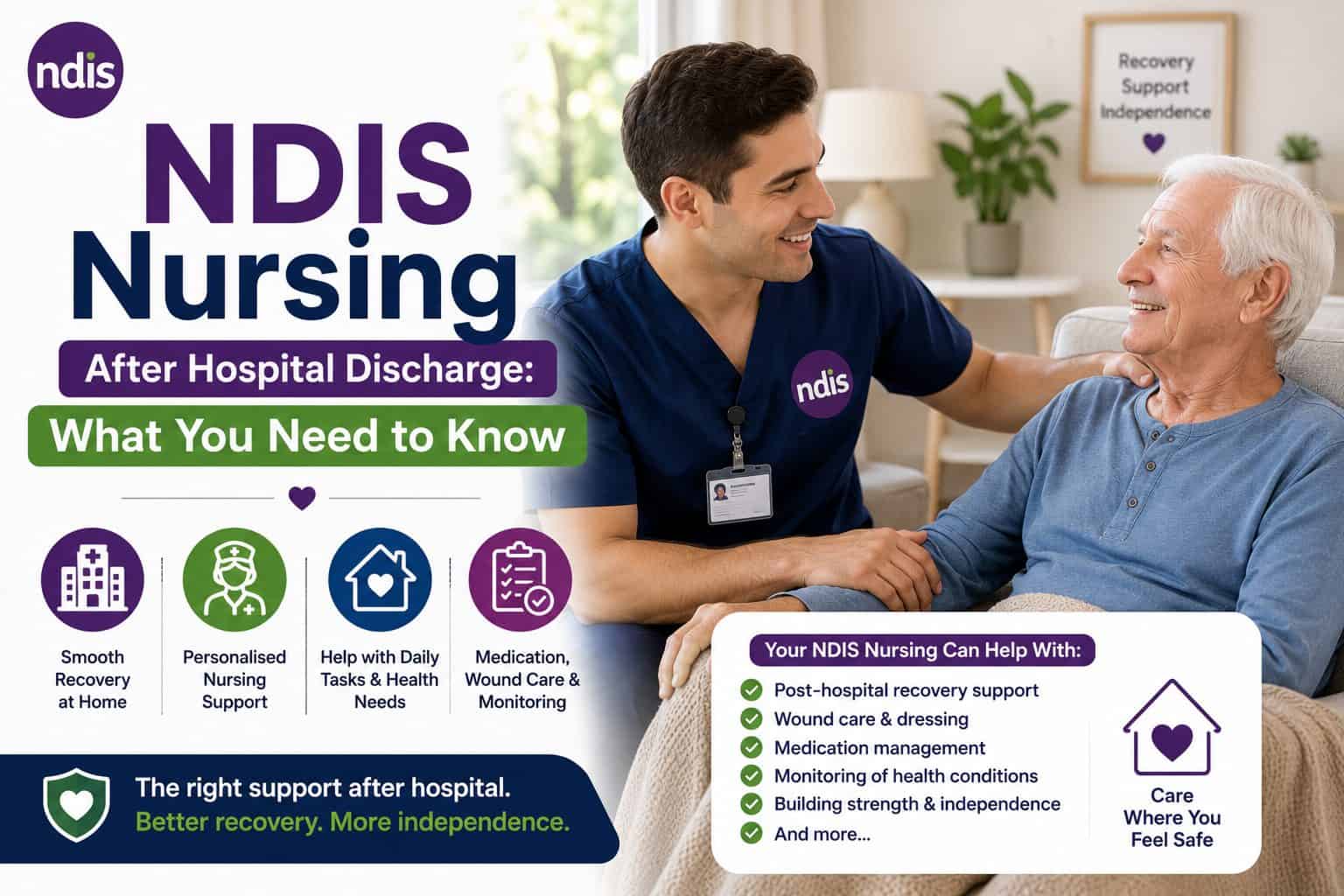
Coming home from hospital should feel like a relief, not a source of anxiety. For a participant with complex health needs, though, the discharge summary often describes care that nobody at home has been trained to give: a new wound, a changed medication regime, a catheter, a feeding tube. Community nursing exists to close that gap, and it works best when it is arranged before the discharge date rather than after. This article sits alongside our life stage and transition support page, which covers the coordination side.
Hospitals discharge patients when they are medically stable, not when their care at home is organised. In the first fortnight the risks are specific: a surgical wound that becomes infected because nobody is checking it, a medication error because the Webster pack does not reflect the discharge changes, a catheter that blocks on a weekend, a pressure area that develops because mobility is worse than before admission, or a deterioration that nobody recognises until it is an emergency. Each of those is preventable with a nurse visiting and a plan in place.
The most useful thing a participant or family can do is involve the community nursing provider and the support coordinator while the participant is still on the ward. That allows the nurse to obtain the discharge care plan and medication list, speak with the ward nurses about how care has been given, train support workers on any new tasks alongside the hospital team where the hospital permits, and arrange equipment and consumables so the first days at home do not depend on a pharmacy run. If the NDIS plan does not fund what is now needed, the support coordinator can request an urgent plan review before discharge.
Hospital social workers and discharge planners across Metro North, Metro South, West Moreton and Gold Coast Health are used to this process. Tell them who your NDIS providers are and ask that they be included.
The first home visit is a reassessment, because participants rarely come home in exactly the state the discharge summary describes. The nurse checks wounds, reconciles the medication chart against the discharge summary and the pharmacy pack, reviews any new equipment or procedures, looks at skin, mobility and nutrition, and confirms that support workers know what has changed. From there the care follows the hospital plan, adjusted as recovery progresses: dressings, medicines, catheter or tube care, monitoring of observations and symptoms, and a call to the GP or the hospital team when something is not going to plan.
Community nursing after discharge is funded from the participant's Core budget as a disability-related health support when the nursing need is connected to the disability. Care that belongs to the acute illness itself, such as a hospital outpatient clinic, remains with Queensland Health and Medicare, and a hospital-in-the-home service may cover a short period after discharge. The NDIA can fund an increase in nursing quickly where the evidence is clear, and a discharge summary plus a nursing assessment is usually enough.
If you are reading this from home with nothing in place, call a community nursing provider today rather than waiting for the next GP appointment. Our nurses can often assess within days, and the assessment itself produces the evidence a support coordinator needs to have nursing funded. Our post-hospital nursing in Logan article describes how this works in one region.
Fastest when it is arranged before you leave. If you contact us from home, we aim to assess within days; the exact timing depends on your area and the care required, and we tell you before you commit.
Your support coordinator, or your LAC or planner, can request an urgent plan review or variation using the discharge summary and a nursing assessment as evidence. Do not wait for the scheduled review.
Hospital discharge planners can refer and will include your providers if you tell them who they are, but the NDIS side is organised by you, your support coordinator and your providers, not by the hospital.
MediHealth Connect provides community nursing across South East Queensland.