
Diabetes and disability often go together, and managing one while living with the other takes more than a script and a glucose meter. Here is how NDIS community nursing supports diabetes management at home, and where the NDIS and Medicare each fit.
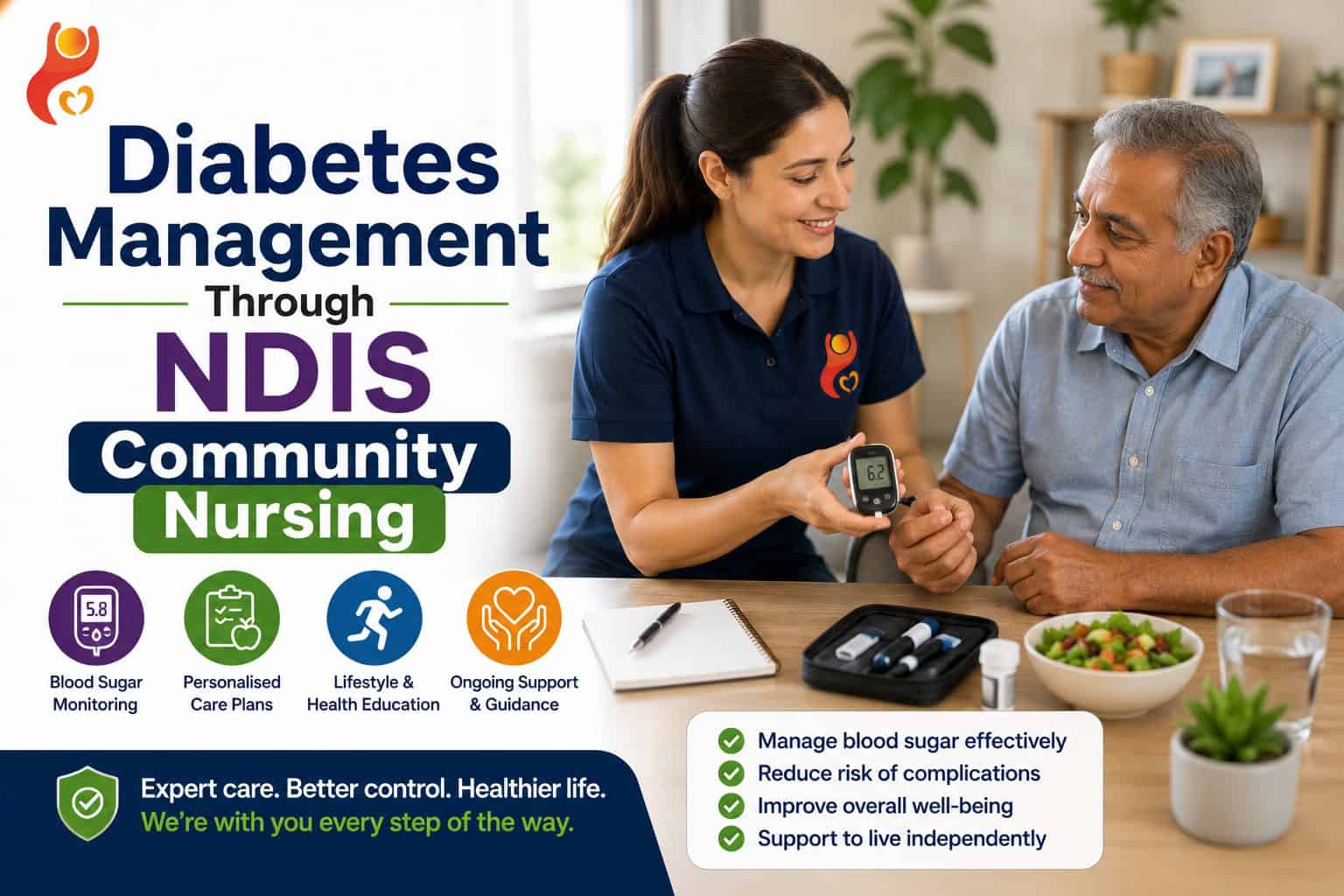
Diabetes is common among NDIS participants, and for many of them the standard model of care, a GP every three months and a diabetes educator once a year, is not enough. Cognitive impairment, reduced mobility, swallowing difficulties, medications that affect blood sugar and support workers who change from day to day all make diabetes harder to manage. Community nursing puts a registered nurse into that gap on a regular basis. If you need NDIS community nursing, our team can help; this guide covers what diabetes nursing at home involves.
The core of it is monitoring and medication. The nurse checks blood glucose readings, looks for patterns rather than single numbers, administers or supervises insulin and other diabetes medicines, and keeps the medication chart accurate when doses change. Where a participant uses a continuous glucose monitor or an insulin pump, the nurse works with the diabetes team on how it is managed at home and who is trained to respond to alarms.
Beyond the numbers, the nurse watches for the complications that diabetes causes: foot problems and slow-healing wounds, skin infections, signs of nerve damage, vision changes and symptoms of high or low blood sugar that a participant may not be able to describe. Foot checks in particular are part of every routine visit for a participant with diabetes, because a small pressure area on a numb foot becomes an ulcer quickly.
Every participant with diabetes on insulin or sulfonylureas needs a written plan for low blood sugar, and everyone who supports them needs to know it. The plan says what readings and symptoms count as a hypo, what to give and when, when to recheck, and when to call for help. A similar plan covers high readings, sick days and missed doses. Our nurses write these plans with your GP or endocrinologist and train support workers on them, because the person present during a hypo is usually a support worker, not a nurse.
Insulin injections and diabetes management are listed in the NDIS High Intensity Support Skills Descriptors. A registered nurse gives insulin at home, and in some cases trains and signs off a support worker to administer a prescribed dose from a pre-set pen under supervision arrangements agreed with your treating team. Dose adjustments, sliding scales and any decision that requires clinical judgement stay with the nurse and your doctor. Participants who want to self-inject, or carers who want to help, can be taught.
Community nursing does not replace your GP, endocrinologist, diabetes educator, podiatrist or dietitian; it makes their advice happen between appointments. The nurse sends readings and observations to your GP, flags trends that need a review, arranges a podiatry referral when a foot problem appears and follows the dietitian's guidance on meals and supplements. Medicare funds the diabetes team through chronic disease management plans; the NDIS funds the nursing where the need relates to your disability.
Nursing for diabetes is funded from Core as a disability-related health support when your disability affects your ability to manage the condition, for example through cognitive impairment, physical limitations or communication difficulties. The NDIA will want a letter from your GP or endocrinologist describing the regime, the risks and why you need nursing rather than self-management. A support coordinator can help you present that at a plan review, and our nurses can provide a clinical assessment.
In some circumstances, yes: a fixed prescribed dose from a pre-set pen, after a registered nurse has trained and assessed the worker and your treating team has agreed. Variable doses, sliding scales and any dose decision are nurse-only.
Diabetes consumables are generally covered through the NDSS (National Diabetes Services Scheme) rather than the NDIS. The NDIS may fund equipment or supports where the need is specific to your disability. Your nurse can help you work out which applies.
It ranges from daily insulin visits to a weekly or fortnightly review, depending on how stable your diabetes is and how much your support workers can safely do. The frequency is set at the first assessment and changes as your needs change.
MediHealth Connect provides community nursing across South East Queensland.