
Support connection, support coordination and specialist support coordination are three different supports with different funding, caseloads and purposes. This guide explains each level, who gets which, and how to tell what your plan contains.
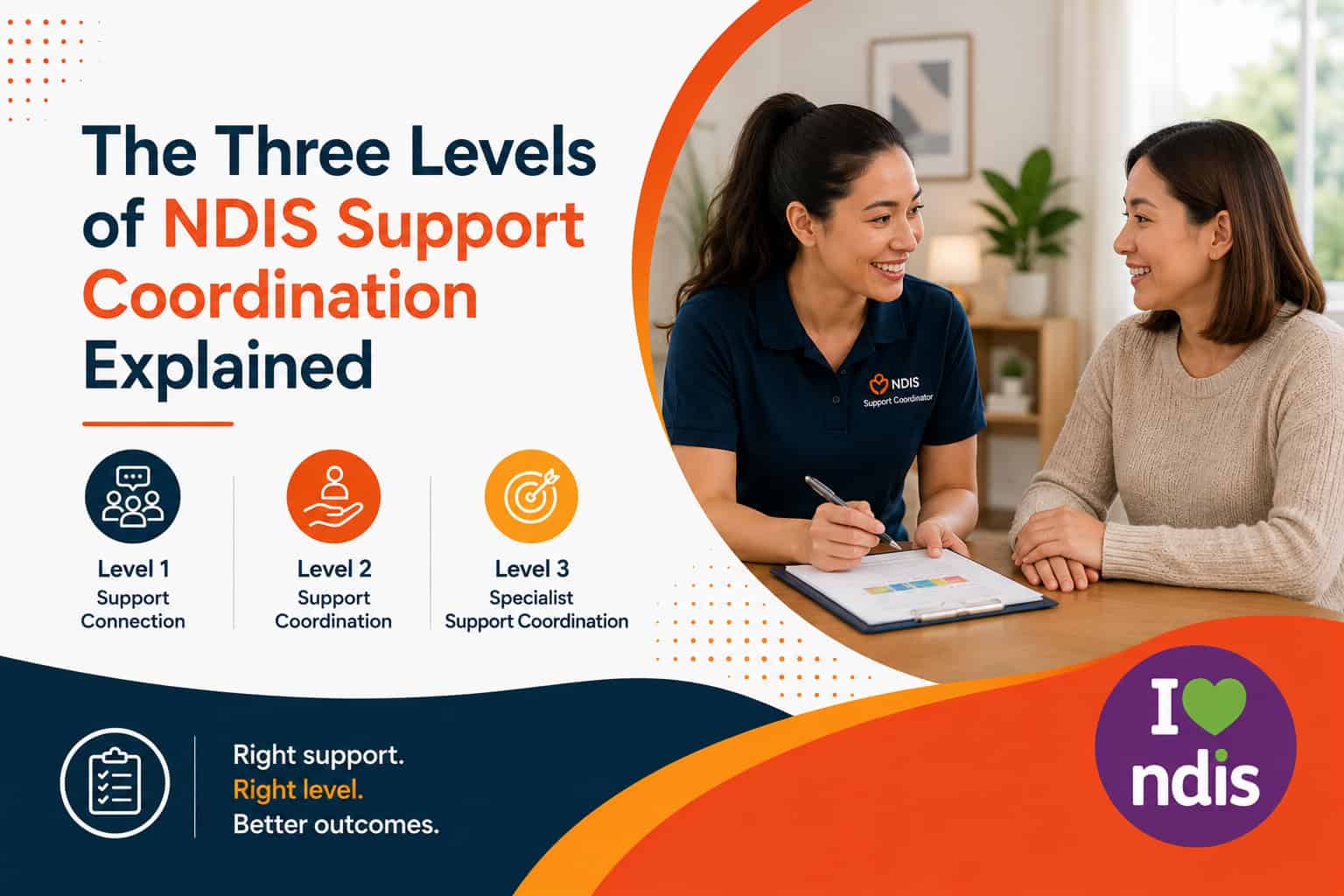
Most participants know their plan has "support coordination" in it. Fewer know which of the three levels it is, and the difference matters: it decides how many hours you have, what your coordinator is expected to do and whether your circumstances are being taken seriously enough. MediHealth Connect provides NDIS support coordination across South East Queensland, and this guide sets out the three levels plainly.
Support connection is the lightest level. It is short-term help, usually a small number of hours, to understand a new plan, identify providers and make the first connections. It suits participants who are fairly confident, have informal supports and mainly need a starting push. Once the services are set up, the coordinator steps back. Support connection is funded under Capacity Building and is often included in a first plan.
Level 2, usually just called support coordination or coordination of supports, is the ongoing service most participants receive. The coordinator helps you understand the plan, finds providers with capacity, sets up service agreements, keeps services working together, resolves problems, monitors how funding is being used and prepares you for plan reviews. It is funded as a set number of hours per year under Capacity Building, and the coordinator is expected to build your capacity to manage supports yourself over time rather than create dependence.
Specialist support coordination is for participants whose situation involves high risk or several systems at once: mental health services, housing instability, child safety, the justice system, hospital admissions, or a history of supports repeatedly breaking down. A specialist coordinator carries a smaller caseload, works more intensively, is expected to bring a relevant professional background, and spends much of their time on crisis prevention and on making agencies that do not normally talk to each other work together. It is funded separately at a higher rate and has to be requested with evidence of complexity. Our specialist support coordination page explains how to ask for it.
The NDIA decides the level at planning, based on your circumstances, the complexity of your supports, your informal network and, for level 3, evidence of risk and multi-system involvement. A participant can move between levels: someone stabilised by a period of specialist coordination may step down to level 2, and someone whose situation deteriorates can ask for level 3 at a review or through a plan variation. The words in your plan tell you the level; if you cannot find them, your coordinator, LAC or planner can.
Any registered support coordination provider can deliver levels 1 and 2. Level 3 requires the provider to be registered for specialist support coordination and to employ coordinators with the right background. If your plan funds level 3, confirm the provider's registration before signing. If your plan funds level 2 but your circumstances look like level 3, a good coordinator will say so and help you build the case rather than stretching a level 2 service across a level 3 problem.
Not usually. A plan funds one level of coordination at a time, although specialist support coordination is sometimes funded alongside a smaller allocation of level 2 hours for the routine work.
Support connection is typically a small block of hours. Level 2 is set per plan based on your needs, often somewhere between a few hours a month and several hours a fortnight. Level 3 is funded on the basis of the complexity evidence and is usually more intensive.
The NDIA, on evidence. Reports from treating clinicians, hospitals, housing or justice agencies describing the risks and the number of systems involved are what support a level 3 request. A support coordinator can help you gather them.
MediHealth Connect provides support coordination across South East Queensland.